Dopamine Nation, A Book Review
This is a review for the book Dopamine Nation, which talks about dopamine, and addiction, and my personal take on the matter
Introduction
The book explores the world of dopamine and its various effects on our lives, and how almost all of us have some form of addiction, whether its social media addiction, cigarettes, weed, alcohol, you name it. and ways to overcome these addictions, it also covers some cool recent science about cold exposure and brain chemistry.
The Rise of Dopamine Addiction
The book explains how our society has become trapped in a dopamine addiction loop. It examines the impact of technology, social media, and the entertainment industry, which have cleverly capitalized on our brain's reward system to keep us hooked.
People nowadays spend countless hours on their phones constantly seeking a hit of dopamine, whether it's a notification, doom scrolling for an intriguing post or a picture, or binge watching short form videos on tiktok or instagram reels.
I personally realized that when I get stuck on a task at work, or if the
work isn't particularly interesting, I would pick up my phone and end up
watching pointless instagram reels for an hour or two. If you think about it,
it's absolutely crazy how much of our attention is being stolen by big tech
companies, and how little control we have over it.
I personally removed the apps from my phone home screen and decided that I
will immediately close my phone the minute I catch myself watching a reel. This
strategy has worked out alright and I managed to significantly reduce the time I
spend on social media apps.
The Consequences Of Dopamine Addiction
The book delves into the consequences of living in a dopamine-driven culture. It discusses the rise of mental health issues such as anxiety and depression, as well as the impact on our attention spans and relationships. The author examines how our constant quest for dopamine can have detrimental effects on our overall well-being.
An unhealthy amount of people claim that they have ADHD, and claim that they cannot focus on work because of the fact, when in reality, they're just addicted to very cheap and instant dopamine that keeps them looking for more and more hits, so they end up interrupting any task at hand to either look for their phone, or a cigarette.
And to make matters worse, Amphetamine, the active ingredient in the street drugs “speed,” “ice,” and “shabu” as well as in medications like Adderall that are used to treat ADHD, increases the release of dopamine by 1,000 percent, which is equal to the amount of dopamine released from ten orgasms.
Now you may wonder why all of this is bad for us, which takes me to the next point.
Pleasure and Pain Are Co-Located
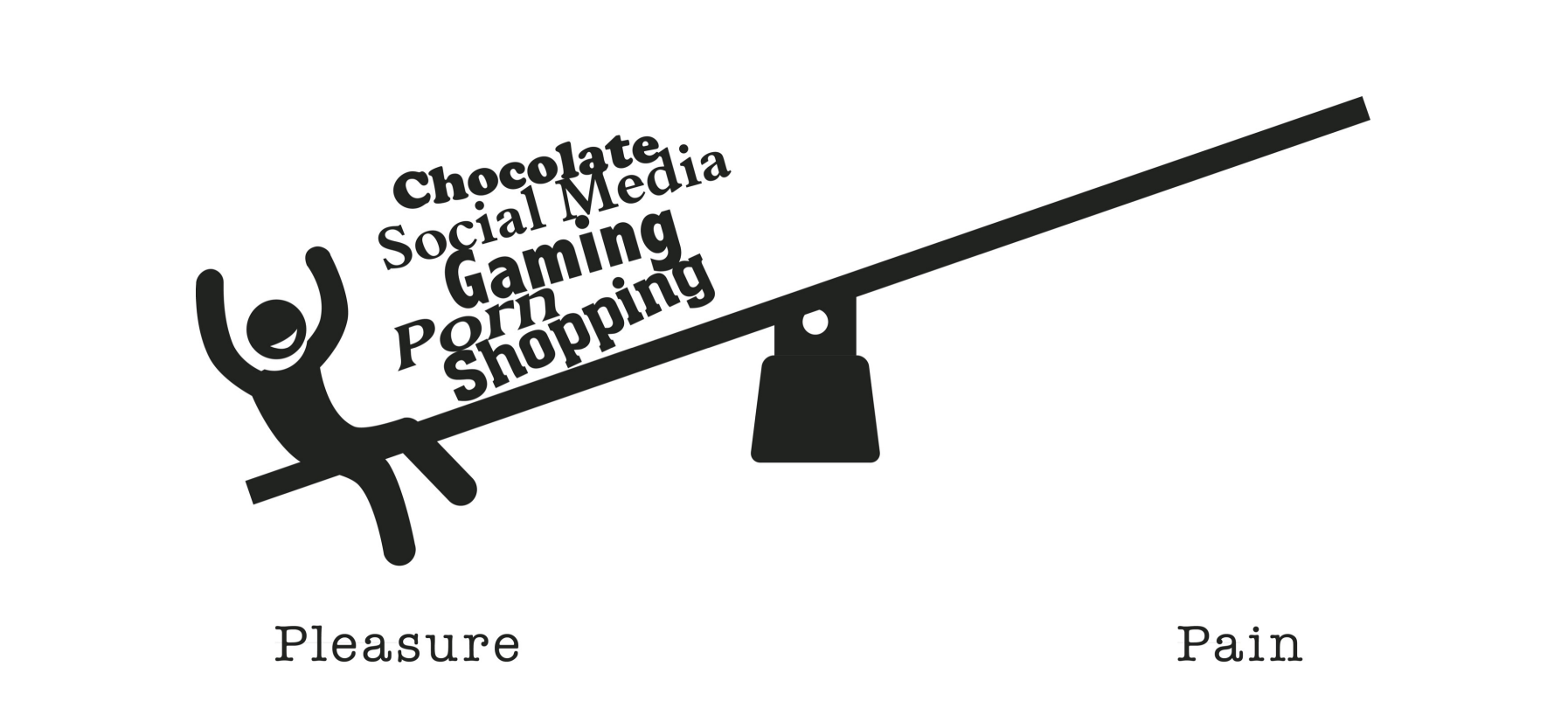
Neuroscientists have determined that pleasure and pain are processed in overlapping brain regions and work via an opponent-process mechanism. Another way to say this is that pleasure and pain work like a balance.
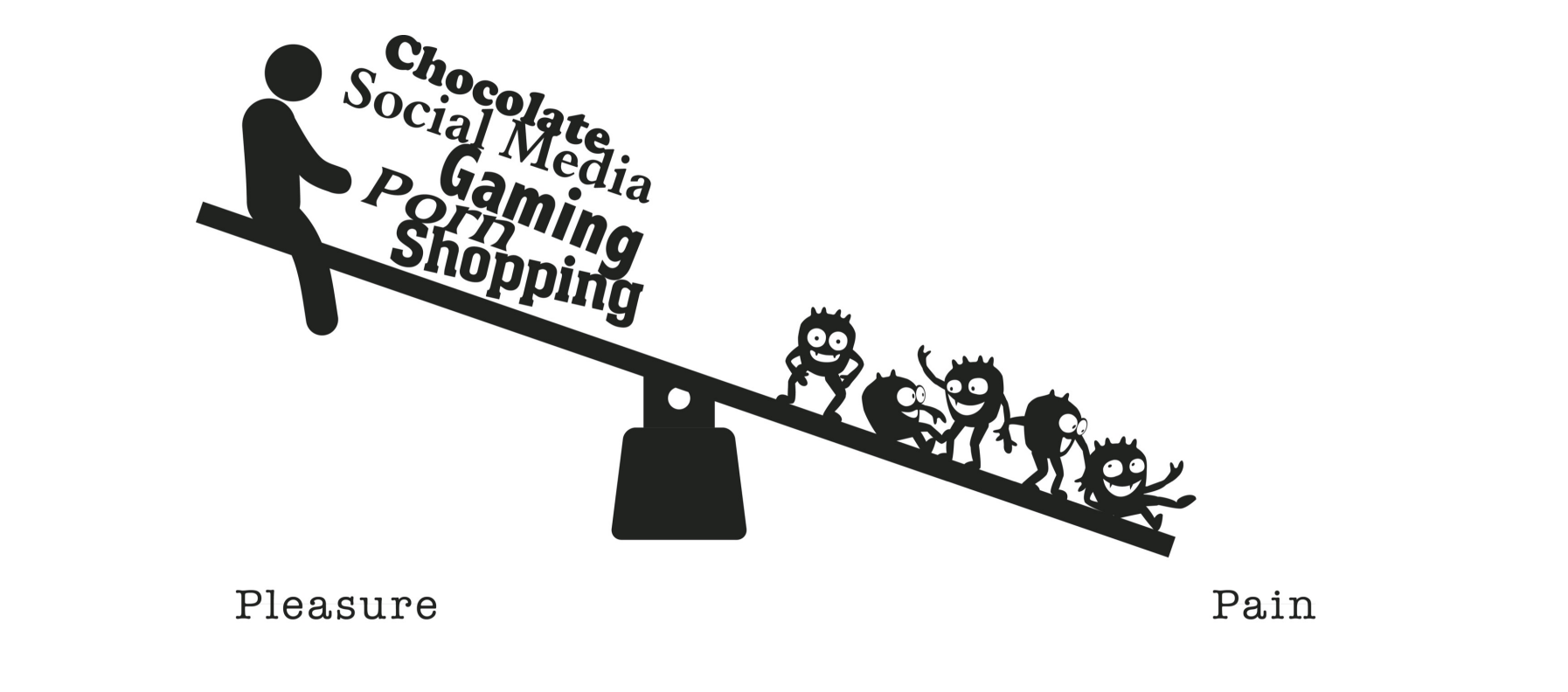
Imagine our brains contain a balance—a scale with a fulcrum in the center. When nothing is on the balance, it’s level with the ground. When we experience pleasure, dopamine is released in our reward pathway and the balance tips to the side of pleasure. The more our balance tips, and the faster it tips, the more pleasure we feel. But here’s the important thing about the balance: It wants to remain level, that is, in equilibrium.
It does not want to be tipped for very long to one side or another. Hence, every time the balance tips toward pleasure, powerful self-regulating mechanisms kick into action to bring it level again. These self-regulating mechanisms do not require conscious thought or an act of will. They just happen, like a reflex.
So the more dopamine we seek, the more pain we eventually experience.
Here's 2 pictures from the book that clarify the point
So if our dopamine works this way, why don't we try to make it work the other way around, as in seek moderately painful experiences to get a pleasure response. (In a healthy way of course). Which brings me to my next point
The Science of Dopamine and Norepinephrine:
One of the very interesting things I learned from this book was a study about cold exposure, which is a moderately painful experience that has some crazy benefits.
Scientists at Charles University in Prague, writing in the European Journal of Applied Physiology, conducted an experiment in which ten men volunteered to submerge themselves (head out) in cold water (14 degrees Celsius) for one hour. This is 57 degrees Fahrenheit. Using blood samples, the researchers showed that plasma (blood) dopamine concentrations increased 250 percent, and plasma norepinephrine concentrations increased 530 percent as a result of cold-water immersion.
Dopamine rose gradually and steadily over the course of the cold bath and remained elevated for an hour afterward. Norepinephrine rose precipitously in the first thirty minutes, plateaued in the latter thirty minutes, and dropped by about a third in the hour afterward, but it remained elevated well above baseline even into the second hour after the bath. Dopamine and norepinephrine levels endured well beyond the painful stimulus itself.
This study basically concludes that something as simple as a cold shower can elevate your mood for hours on end without having to resort to any other form of dopamine.
The author then talks about addiction and the framework she has come up with for dealing with it, which I personally found useful in many ways.
The framework is easily remembered with the acronym DOPAMINE, which I will explain next.
The DOPMAINE framework
-
D stands for Data: we begin by collecting as much data as we can on our addiction, for example: smoking cigarettes.
When do we smoke cigarettes? What makes us want to smoke them? What is smoking triggered by? How many cigarettes do we smoke per day, etc. This data helps us understand more about our addiction, and the more we understand, the more we're able to get rid of the addiction.
- O stands for Objectives for using: People use high dopamine substances and behaviors for all kinds of reasons: to have fun, to fit in, to relieve boredom, to manage fear, anger, anxiety, insomnia, depression, inattention, pain, social phobia... the list goes on. Being aware of the reasons is key to recovery.
- P stands for Problems that co-exist with using, We'll use smoking as an example again, some of the problems that come with smoking are health issues, loss of focus, risk of lung cancer, etc. Being aware of the problems can also help with recovery.
-
A stands for Abstinence. Abstinence is necessary to restore homeostasis, and with it our ability to get pleasure from less potent rewards, as well as see the true cause and effect between our substance use and the way we’re feeling. To put it in terms of the pleasure-pain balance, fasting from dopamine allows sufficient time for the balance to go back to the level position.
The question is how long do we need to abstain in order to experience the benefits of stopping?
The general answer is around 4 weeks. Some people need less than four weeks to reset their reward pathway, and others need longer. Those who have been using more potent drugs in larger quantities for longer duration will typically need more time. Younger people recalibrate faster than older people, their brains being more plastic. Furthermore, physical withdrawal varies drug to drug. It can be minor for some drugs like video games but potentially life-threatening for others, like alcohol and Benzodiazepines. In such extreme cases, it's usually best to consult your doctor before you attempt any major change.
Sometimes, people try to swap one drug for another: cannabis for nicotine, video games for pornography. This is seldom an effective long-term strategy. Any reward that is potent enough to tip the balance toward pleasure can itself be addictive, thereby resulting in trading one addiction for another (cross addiction). Any reward that is not potent enough won’t feel like a reward, which is why when we’re consuming high dopamine rewards, we lose the ability to take joy in ordinary pleasures.
-
M stands for Mindfulness. Mindfulness practices are especially important in the early days of abstinence. Many of us use high-dopamine substances and behaviors to distract ourselves from our own thoughts. When we first stop using dopamine to escape, those painful thoughts, emotions, and sensations come crashing down on us.
The trick is to stop running away from painful emotions, and instead allow ourselves to tolerate them. When we’re able to do this, our experience takes on a new and unexpectedly rich texture. The pain is still there, but somehow transformed, seeming to encompass a vast landscape of communal suffering, rather than being wholly our own.
- I stands for Insight. The simple exercise of abstaining from our drug of choice for at least four weeks gives clarifying insight into our behaviors. Insight that simply is not possible while we continue to use.
-
N stands for Next Steps: The vast majority of people who are able to abstain for a month and experience the benefits of abstinence nonetheless want to go back to using their drug. But they want to use differently than they were using before. The overarching theme is that they want to use less.
An ongoing controversy in the field of addiction medicine is whether people who have been using drugs in an addictive way can return to moderate, non-risky use. Some emerging evidence suggests that some people who have met criteria for addiction in the past, especially those with less severe forms of addiction, can return to using their drug of choice in a controlled way, without falling back into addiction.
But the wisdom of Alcoholics Anonymous suggests that abstinence is the only option.
-
E stands for Experiment. This is where people go back out into the world armed with a new dopamine set point, and a plan for how to maintain it, whether the goal is continued abstinence or moderation.
The question of how to moderate is becoming harder and harder to answer in the modern world though, because of how embedded the stimuli are in our environment, like social media for example. Which brings me to the next tool, which I personally found very helpful in getting over my smoking addiction.
Self Binding
The idea of self binding is basically putting restrictions on yourself that stop you from engaging in the addictive behavior to begin with. The idea might sound trivial but it's actually tremendously helpful. It's like a preset rule that you put for yourself and stick to it no matter what. I personally used this tool to get over my smoking addiction, and the way I did it was that I put a rule for myself that I will stop buying cigarettes, as simple as that. And this simple self binding technique got me from smoking 2 packs of cigarettes a day, to an occasional cigarette or two.
I think this is one of the best tools to help with addiction and it can be used with all other addictions as well.
Conclusion
The book covers a lot more about self care, well being, relationships, and more, but I'm tired of writing so I'll end the review here. It's a really nice, and also entertaining read, so if you find yourself in the market for a new book, I'll definitely recommend this one. Happy reading :)
Back to posts